In short: Collegiate esports has moved from dorm-room clubs to varsity programs. Member schools in the National Association of Collegiate Esports (NACE) grew from 42 in spring 2018 to over 200 by late 2022. Campuses invest because esports supports recruitment, retention, and community — but a lounge also needs infrastructure a lean IT team can realistically run.
From clubs to varsity programs
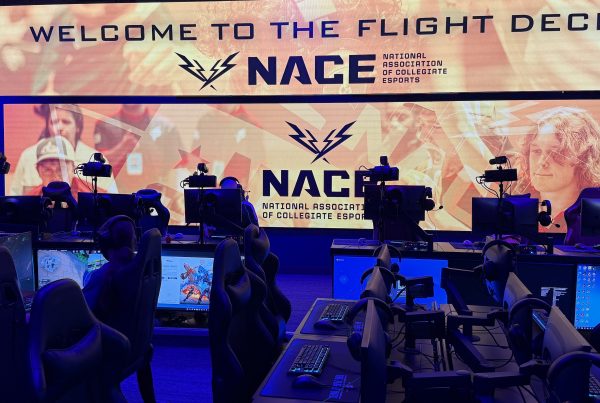
Collegiate esports is one of the fastest-growing areas in campus recreation. NACE, founded in 2016, counted just 42 member colleges and universities in spring 2018 and more than 200 by late 2022 — a clear signal that varsity esports has gone mainstream in higher education.
The growth isn’t only about competition. For many institutions, an esports program is a front door: a way to reach prospective students, give current ones a place to belong, and connect a popular pastime to real academic and career pathways.
Why universities are investing
The reasons schools build esports programs tend to cluster around four themes:
- Recruitment and enrollment — a visible esports program reaches students who might not engage with traditional athletics.
- Retention and belonging — a dedicated space and team give students community, which supports persistence.
- Pathways and careers — programs increasingly connect to coursework and roles in event production, marketing, broadcasting, coaching, and IT.
- Facility utilization — a gaming lounge turns underused campus space into a busy, programmable venue.
What a campus esports venue actually requires
The fun part — high-spec gaming PCs and consoles — is the easy part. The harder question is operational: who keeps the room running, and how? A campus lounge needs three layers working together:
- Identity — students should sign in with the campus account they already have, not a separate lounge login. That means single sign-on (SSO) tied to the institution’s identity provider.
- Management — booking, session time, game launching, and usage reporting, so a small (often student) staff can run the space.
- Infrastructure — a way to keep every PC identical, patched, and clean without reimaging each machine by hand. This is where diskless boot matters: every PC loads one shared image from a central server and resets to a known-good state on reboot.
Get those three right and the room more or less runs itself; get them wrong and you’ve bought expensive hardware that needs constant babysitting.
A real example: Cornell University
Cornell’s Esports Gaming Lounge is a working model of this approach: 13 Alienware gaming PCs that boot diskless from a central server (no local drives), with students logging in through ggLeap using their Cornell NetID, and reservations handled online. We broke down how it’s built in How Cornell University Built a Scalable Esports Lounge Using Diskless Infrastructure.
FAQ
How fast is college esports growing? NACE member institutions grew from 42 in spring 2018 to more than 200 by late 2022, and varsity programs continue to expand across North America.
What software do universities use to run an esports lounge? Most campus lounges pair a management layer (player accounts, booking, session time, SSO login) with diskless infrastructure that keeps every PC identical. ggCircuit provides both: ggLeap for management and ggRock for diskless boot.
Can students log in with their university account? Yes. With SSO, students sign in to the gaming PCs using their existing campus credentials (for example, a NetID), so there are no separate lounge accounts to manage.
Next steps
- Planning a campus venue: Esports Venue Services
- The infrastructure layer: Diskless Boot Software
- The management layer: Esports Venue Management Software
- More for higher ed: University Esports Venues: Finding Your Path
Source: Member-growth figures from the National Association of Collegiate Esports (via Wikipedia: NACE).