ggRock 1.6
📅 Release date: May 26, 2026
Release goal
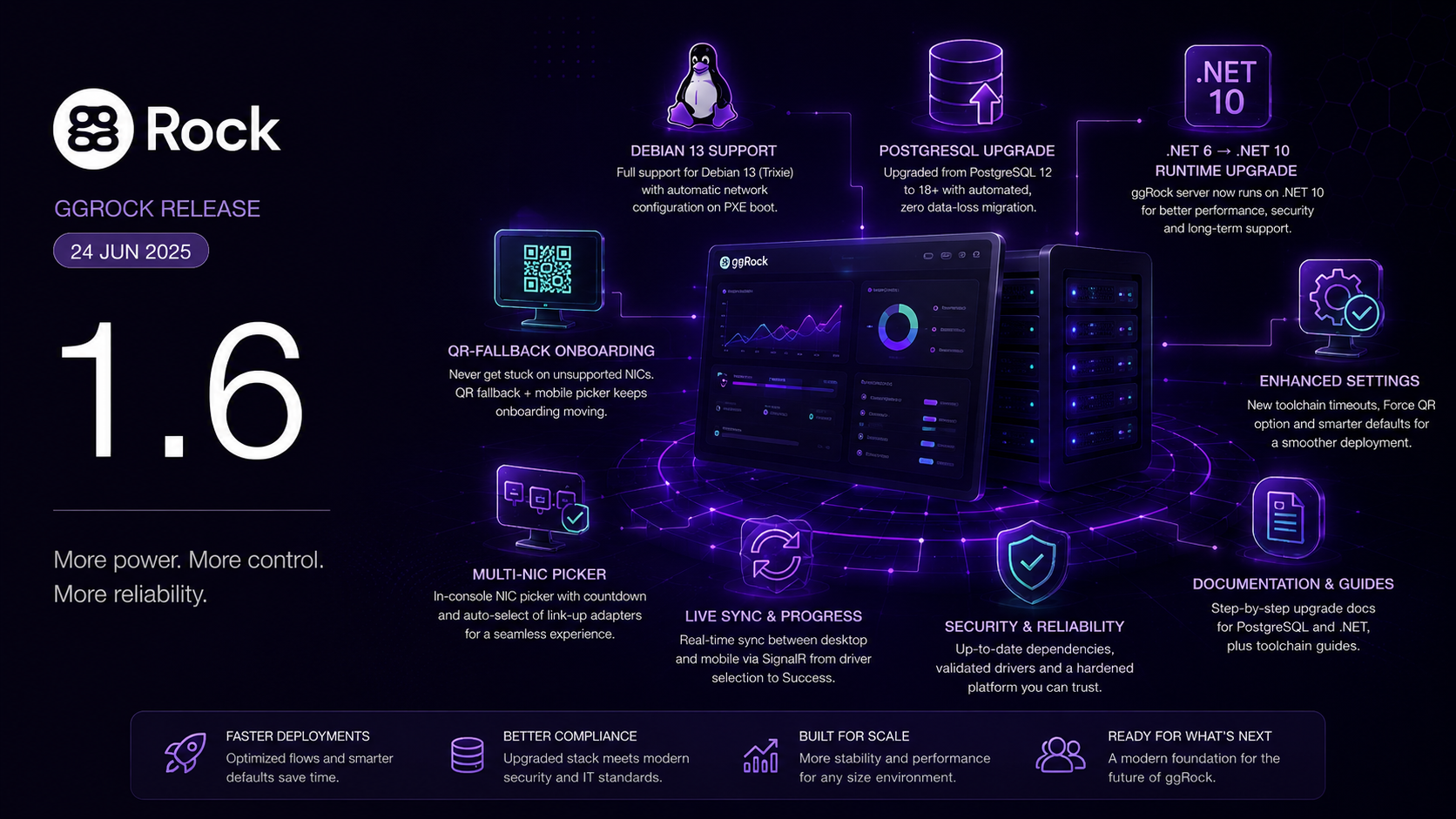
The primary goal of ggRock 1.6 is to make onboarding resilient on real-world hardware and to modernize the server platform end-to-end. This release introduces a brand-new QR-fallback onboarding path for the WinPE toolchain, full Debian 13 support for the PXE boot system, a major PostgreSQL upgrade from version 12 to 17, and a runtime migration from .NET 6 to .NET 10 — bringing ggRock to a fully supported, secure and audit-friendly stack.
🥇 Headlining features
📱 QR-fallback Onboarding for the WinPE Toolchain

The WinPE toolchain has been reworked to never get stuck on unsupported NICs again. Every PCI network device is now enumerated — including ones with no Windows driver bound — and when the live onboarding path can’t complete, the toolchain hands off to a mobile-friendly QR fallback so the operator can finish setup from their phone.
- Multi-NIC picker in the WinPE console: machines with multiple network adapters now get an in-console picker with a configurable countdown. The default highlights an adapter with link up, so single-NIC and standard multi-NIC machines just work.
- QR fallback: when no driver is available, DHCP fails, the server is unreachable, or the live-flow timeout expires, the console renders a full-screen QR pointing to
https://<ggrock-ip>/qr-onboard/<sessionId>. Scanning it opens a stripped, mobile-friendly picker that shows detected hardware (NIC model, motherboard, BIOS) and a driver list with Auto (PnP) as the first option — matching the existing console picker. - Live progress on both sides: the desktop “Add Hardware” dialog now has an
AwaitingMobileDriverPickstate, and SignalR keeps both the phone and the desktop in sync from driver selection all the way to “Success”. - New toolchain settings in the web UI: alongside the existing MAC field, admins can now configure NIC auto-select timeout (default 10s), Driver auto-select timeout (default 60s), QR-fallback timeout (default 60s), and a Force QR toggle for fleets with known unsupported NICs.
- Backward compatible: capability discovery is driven by
media/features.jsonin the WinPE pack and aggrock-session.jsonsnapshot insideboot.wim, so old toolchain ↔ new server and new toolchain ↔ old server combinations keep the legacy flow.
🐧 Debian 13 Support

ggRock’s PostgreSQL dependency has been upgraded from PostgreSQL 12 to PostgreSQL 17+, aligning the platform with a currently supported, secure release. This unlocks compliance with IT audit and security standards that many managed-service customers require.
- Schema and data compatibility: all existing ggRock schemas, stored procedures, and data migrations have been validated against PostgreSQL 17+.
- Automated migration: the upgrade ships with an automated, tested migration path from PostgreSQL 12 to 17+ — with no data loss — runnable in both test and production environments.
- Installer integration: the ggRock installation package now installs or detects PostgreSQL 17+ during setup, so fresh installations are on the supported version from day one.
- Documentation: step-by-step upgrade documentation is available for customers and managed service providers — please follow it before upgrading production environments.
🐘 PostgreSQL Upgrade (12 → 17+)

ggRock’s PostgreSQL dependency has been upgraded from PostgreSQL 12 to PostgreSQL 17+, aligning the platform with a currently supported, secure release. This unlocks compliance with IT audit and security standards that many managed-service customers require.
- Schema and data compatibility: all existing ggRock schemas, stored procedures, and data migrations have been validated against PostgreSQL 17+.
- Automated migration: the upgrade ships with an automated, tested migration path from PostgreSQL 12 to 17+ — with no data loss — runnable in both test and production environments.
- Installer integration: the ggRock installation package now installs or detects PostgreSQL 17+ during setup, so fresh installations are on the supported version from day one.
- Documentation: step-by-step upgrade documentation is available for customers and managed service providers — please follow it before upgrading production environments.
⚙️ .NET 6 → .NET 10 Runtime Upgrade
The ggRock server has been migrated from .NET 6 to .NET 10. This brings the platform back onto a fully supported, long-lived runtime and unlocks the performance and security improvements introduced across the .NET 7/8/9/10 cycle.
- No configuration change required for operators in the standard managed flow — the installer pulls the right runtime automatically.
- Build and obfuscation pipeline have been validated end-to-end against the new runtime, including license activation, IPC channels (ServiceWire), SignalR (
AdminHub), and toolchain orchestration. - Foundation for future work: a modern runtime is now in place for upcoming features that depend on newer .NET APIs.
🐞 Bug Fixes
- Build pipeline — silent migration name corruption: fixed an issue in
Source/BuildScripts/build-ggrock.ps1where a failingdotnet ef migrations list --no-buildcommand would silently store its own error string as the migration name in the build database. Build outputs and the update feed are now consistent. - We set the default prometheus retention size to 15GB to prevent logs from filling the whole partition space up.
🫴 Contribute with us!
- Help shape the future of ggRock by contributing to our roadmap. Share your ideas and vote on features here: Productboard