One of my favorite parts of this industry is getting the chance to immerse ourselves in the amazing programs we work with and hear their stories firsthand. We recently sat down with Greg Durham and Brian Smith from Georgia Tech Esports to learn more about the community, innovation, and momentum surrounding their growing program in Atlanta.

SPAWN POINT
Can you introduce yourself and your role at Georgia Tech Esports?
Greg: My name is Greg Durham, and I serve as the Director of Partnerships and Programs with Campus Recreation here at Georgia Tech. I provide leadership support to the Programmatic and Corporate Development efforts for our team.
Brian: I am Brian Smith and I am the Georgia Tech Senior Director of Campus Recreation. I provide fiscal stewardship, oversight, and strategic direction for all of Campus Recreation’s programs, services, operations and facilities.
What’s your personal path into esports and emerging technology?
Greg: I have been gaming my entire life. Prior to my time at Georgia Tech, I worked at Creighton University, where I helped open the Gaming Lounge. I also directed the first ever NIRSA Esports Tournament which brought in over 100 teams.
Brian: I played console video games through college. Think original Nintendo Mario Brothers, Duck Hunt, Tecmo Bowl, Zelda. Then I graduated to Mario Kart, 007, Madden, FIFA, and NCAA Football. During my time at UCLA, I became very involved with collegiate esports because of our student leadership within our Esports club. They were very involved in the LA Esports scene and passionate about the future of Esports. I saw an opportunity to make a difference in the lives of students that I did not interact with on a regular basis. I quickly got up to speed on as much as I could regarding Esports. We made the UC Esports Initiative which is a collective competition amongst all the University of California schools and created the first PAC E League of Legends competition featuring all the PAC12 schools that had Esports programs which finished with an on-site competition for the Final 4 at UCLA. We were also able to secure multiple sponsorships for the program from RAZER and MSI. We had also set up a relationship with T1 to help our students receive internships and T1 would provide development opportunities on campus for the students. We also began hosting competitions for local high schools on campus and creating an environment to grow the Esports at the high school level. Finally, we built out a space for competition for the Esports Club and were in the plans for two more by the time I left. Those have now come to fruition. All of this was a great introduction to the opportunities that could be available if the proper leadership was in place at Georgia Tech.
How did esports take shape at Georgia Tech and what has that growth looked like?
Greg: Our senior director, Brian Smith, led much of this effort prior to my arrival at Georgia Tech. Prior to arriving at Tech, Brian served at UCLA where he helped build their esports program. When he took the job here at Tech, it was a passion project of his. Shortly after my arrival, we were able to connect with the GT Esports Club, who had a massive community, several talented rosters, but nowhere to play on campus. Since 2023, we have worked closely with them, involving them in plans for the physical space, bringing them under our Club Sports umbrella, and helping them achieve their goals.
Club leadership transitioned in 2024 and they made a dedicated effort to see what else could be achieved if they leaned into our support. DJ Fratt, the current President, was heavily involved in Esports going back to his Georgia high school days and that experience has influenced the club to what more and us as staff to know that we can invest in this program. They continue to add titles with no shortage of interest, and the teams are becoming increasingly competitive.

COMMUNITY FIRST
What makes the Georgia Tech esports program unique?
Greg: Our students make our program truly unique. The Esports Organization had such a strong community before Campus Recreation got involved, that getting our program stood up was easy. I’ve been part of campuses, or talked to colleagues who know they want esports, but don’t have students to champion it. What also makes us unique are the endless possibilities, being at one of the top tech schools in world, in downtown Atlanta, we are uniquely positioned to be real difference makers in the industry, not just collegiate, but as a whole.
How do you think about community beyond just competitive teams?
Greg: Gaming has the opportunity to be a great unifier. With the creation of our space, and the formalization of the esports and gaming program, we are creating new communities. With our lounge in our recreation center, we have data that shows that we’re now getting students in our space who have never visited before. No longer do students have to sit in their residence hall rooms to come together in community and game. Beyond that, we are going to look to create even more opportunities through community days, game-release parties and more.
How do students get involved across different roles like players, creators, and organizers?
Greg: If a student has an idea, we want to hear it. The esports organization is the voice of the students for all things gaming and esports on campus. In the future, we are going to partner with professional teams, local creators and tournament organizers to hopefully bring these events to our space to provide students with those opportunities. Beyond that, this space has created opportunities for student employment, competition and real-world broadcasting & production opportunities. We are excited to see this space go.

GameFest LIVE HERE
How was GameFest this past weekend?
Greg: Gamefest was a hit. For the first time in over 10 years it was hosted in the Recreation Center, once again proving that our Rec Center is more than barbells and basketballs. It’s truly a hub where anyone can come to socialize, recreation and enjoy activities they love.
What does an event like GameFest mean for your program and the campus?
Greg: GameFest is a cornerstone event that demonstrates the power of student-led initiatives. Hosting it within the Campus Recreation Center created a powerful synergy with the launch of our new physical space, proving that esports is a vital bridge between traditional recreation and modern student engagement
What stood out most from this year’s event?
Greg: What impresses me most is that GameFest remains entirely student-run. Witnessing our students navigate the complexities of event management, from high-level planning to live execution, highlights the incredible leadership and technical skills being developed within our gaming community.
How do events like this help grow the overall esports community?
Greg: Gamefest at GT is a cornerstone of the regional gaming industry, honestly. Between our BYO opportunities, and our partnership with Alienware, we provided something for everyone. It was a low barrier to entry event, which speaks right into the accessibility piece we are passionate about.

THE INFRASTRUCTURE LAYER
What challenges did you face before implementing structured systems?
Greg: We did our research before opening our space, and we knew that title management, updates, and operations were going to be a challenge without a structured system. Fortunately, we had prior experience with ggLeap and ggRock from previous institutions and knew that it would be a great fit for our programs and what we wanted to do.
How have tools like ggLeap or ggRock changed your day-to-day operations?
Greg: ggLeap and ggRock have made managing this space infinitely easier, saving time, money, and headaches when it comes to how our software and hardware is managed. Without ggRock, we would be manually updating everything and troubleshooting issues on our own.
What real outcomes have you seen since adopting these systems?
The gg suite of tools has saved us time, headaches, and money. Without it, we’d be doing most of our processes manually. The support team is incredible, and the tools itself are second to none. It has made management of our space significantly easier. What I appreciate most about it is the ease of the system. It is easy to learn, and even easier to train staff on.
How does your setup support both casual players and competitive teams?
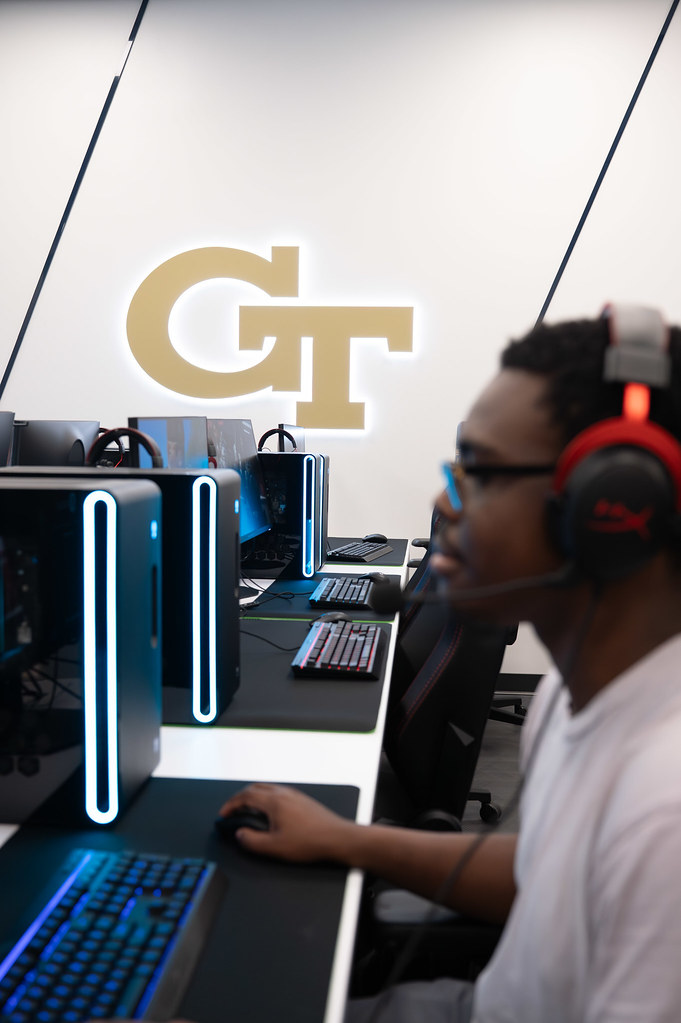
Greg: The Gaming and Esports Lounge at GT has three rooms, the largest of the rooms is our open play room, which features 22 Alienware setups. The next room is our team room, which has an additional 12 Alienware setups that are tied into our broadcast and production room. This setup supports our competitive teams at a very high level and also the everyday student who just wants to get a few scrimmages in, update their farm in Stardew Valley, or get a few 2K of FC matches in at our console station in the open play room.

WHAT COMES NEXT
What have you learned building this program?
Greg: The most important part for me is listening to the students who are the end users and the reason for us building this program. Students have wonderful ideas, and we worked hard to incorporate their ideas at every phase of the project. Since opening, we’ve also learned that not all of our pre-designed plans will work out exactly as we anticipated, so staying flexible, using your resources and continuing to lean on students are things we’ll need to continue to do to be successful.
Where do you see collegiate esports heading in the next 3 to 5 years?
Greg: I think collegiate esports is going to stabilize over the next 3-5 years. It’s not going anywhere, but I’m not convinced it will become a true NCAA Varsity model given everything happening with Athletics and NIL, though I do think it would be cool! Given this, I think it creates opportunities for as at the recreational and club level. We can build something competitive and accessible, without the constraints that comes along with NCAA programs. I see growth beyond competition, opportunities in research and hands-on student experiences like game development, shout casting and event production.
What’s next for Georgia Tech esports?
Greg: What’s next for GT Esports is building intentionally on the strong foundation that’s been created by continuing to improve the space, enhance the student experience and expand our reach through the right partnerships, including opportunities with professional organizations and teams. We’ve made significant progress in a short time, and by staying closely connected to our students and evolving with them, we’re focused on taking the program to the next level in a way that is both competitive and accessible.
How can partners continue to support and grow with you?
Greg: We are always looking for more partners who are interested in ongoing relationships. We want partners to keep us in mind and stay connected. As new opportunities emerge, we want to be in the loop early so we can explore how to align and build something incredible together. We are confident in the value of what we offer and the experience we’re creating for students. We know where we want to go, and we know that we’ll need likeminded partners willing to collaborate on ways to enhance relevance, strengthen storytelling and create more impactful opportunities for our students.